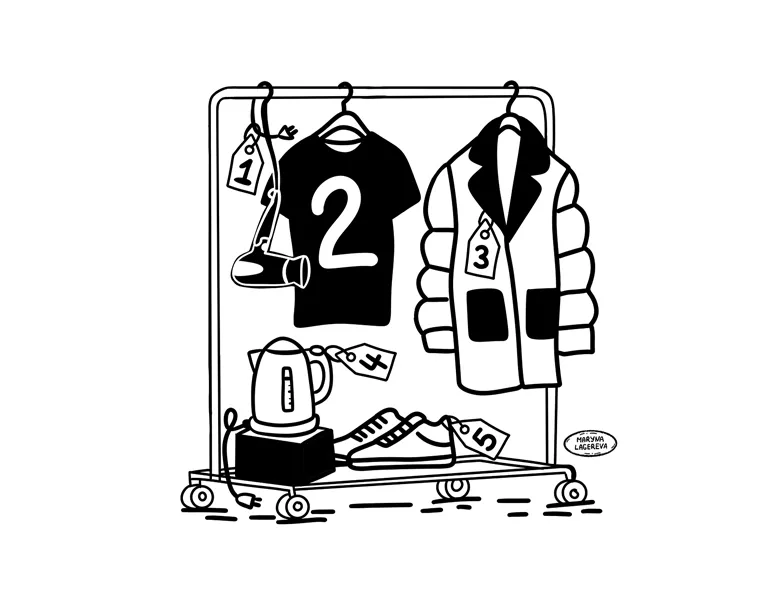
Take an inventory of my apartment with me. There is a vinyl turntable whose stylus should be brushed and whose belt has a lifespan I have never once checked. A guitar that would like its strings changed more often than they are, and its fretboard oiled at intervals I could not name under oath. A keyboard, the humble computer kind, that deserves better than the crumbs it lives with. And a drawer of t-shirts that have one simple wish, to be turned inside out and washed cool, a wish I remember roughly every second load.
None of this is exotic knowledge. It is a hundred small, slightly dumb things (brush this monthly, oil that twice a year, never wash this hot), and I know maybe a third of them and act on fewer. Meanwhile my car, the one object in my life with a maintenance book and a garage that calls me, gets flawless care. The difference is not love. The difference is that somebody built the system of reminders for cars and nobody built it for everything else.
Keep is that system. You photograph an object, and Keep identifies it and hands back its care sheet: what this thing needs, how often, and how to do it in plain words. Then it does the part no manual ever did. It remembers for you. The right nudge at the right rhythm (strings in March, belt check in autumn, descale the coffee machine now), and a log of everything you have done, a service book for your whole material life.
Where this idea came from, and what freed it
The first version of this idea, in my 2024 notes, was a Shopify plugin that offered AI-generated care guides to customers after checkout, a rare use of AI that pushed longevity instead of another purchase. I still like that instinct, but it was a feature trapped inside someone else’s checkout. The concept only becomes itself when it belongs to the owner, not the merchant, because care is a relationship with the things you already have, across every brand, for years. So the plugin became an app, and the merchant became, as we will see, the distribution channel instead of the product.
The timing argument is simple and two-sided. AI vision finally makes onboarding effortless. A photo is enough to recognize a garment, an instrument, or an appliance and generate a sane protocol, which kills the data-entry wall that murdered every previous attempt at this category. And the culture has moved. Repair, longevity, buy-less-but-better have gone from fringe virtue to mainstream common sense. People increasingly own fewer, better things on purpose. Nobody has given them the tool that honors that choice.
Key Features
- Photo in, ritual out. Ten seconds per object: snap it, confirm what it is, done. No forms, no barcode hunting, no cataloging project. The clothing case is even better: photograph the care label itself and Keep translates those hieroglyphic laundry symbols into one plain sentence.
- Care sheets in human words. What to do, how often, with what, and the two mistakes that actually ruin this kind of object. Written for someone who has never conditioned leather, not for a forum of enthusiasts.
- Reminders with taste. This is the product’s soul, and its biggest risk, so it is a feature with opinions: few notifications, batched into a weekly care ritual, a quiet Sunday digest of the two or three things whose moment has come. An app that nags about fretboard oil on a Tuesday morning gets deleted by Thursday.
- The service book. Every care act logged against the object, which sounds bureaucratic until you sell your turntable and hand the buyer a documented maintenance history, the same reason a car with a full service history is worth more. Cared-for objects hold value; Keep makes the caring provable.
- Household sharing. The washing machine, the plants, and the good knives belong to everyone; so do their rituals.
- Honest sourcing. Where an official manufacturer care guide exists, Keep finds it, links it, and defers to it. Generated advice fills the gaps, clearly labeled as such, and stays conservative on anything valuable or delicate. The app’s first rule is the medical one: do no harm to the patient.
The graveyard, and why Keep sidesteps it
Home-inventory apps are a documented graveyard, and the cause of death is always the same: they asked people to catalog their homes, and nobody on earth wants a second job as their own possessions’ librarian. Keep’s answer is structural. There is no catalog to complete, no progress bar guilting you toward exhaustiveness. One object gives value in ten seconds, the first reminder proves the point, and the collection grows the way a music library does, one addition at a time, whenever a thing feels worth keeping alive. The inventory is a side effect, never the task.
The second graveyard is generic reminder apps, which fail here for the opposite reason. They make you author every rule yourself, and nobody knows the right cadence for turntable belts. Keep’s knowledge layer, the care sheets with their built-in rhythms, is the part a to-do app cannot fake.
The honest tensions
Advice quality is the real risk, stated plainly. A wrong instruction can shrink a sweater or strip a fretboard, and an AI generating care protocols will sometimes be wrong. Hence the sourcing hierarchy above (official guides first, conservative defaults, and visible uncertainty), and hence starting with categories where the knowledge is stable and the failure cost is low. Notification fatigue is the second killer, addressed by design rather than promises: the weekly ritual, aggressive batching, and cadences that err long. And the market question deserves honesty too. This is a quiet utility, not a viral toy. Its growth engine is usefulness and gifting culture, and its natural scale is a beloved tool, not a social network.
Monetization
Free for a handful of objects, enough to fall for the Sunday ritual, then a modest subscription for unlimited objects, households, and the full service-book export. The second engine is the one my Shopify notes accidentally predicted: durable-goods brands as a channel. A knifemaker, a leather workshop, a hi-fi brand, anyone whose pitch is “this will last decades”, has every reason to slip a Keep card into the box. Scan it, and the object you just bought arrives with its care program preloaded, straight from the maker. The brand gets provably longer-lived products and a customer relationship that outlasts checkout, and Keep gets acquisition through the objects people already intend to care for. Brands pay for that placement. The owner never pays for the brand’s own instructions.
Next Steps: How I’d Build It
Start with five categories where care is codified and stakes are friendly: clothing via the label decoder, instruments, coffee gear, leather goods, plants. The label decoder might be the wedge all by itself (photograph the tag, get one sentence), because everyone has stood in front of a washing machine holding a garment like it was a bomb. Build the care-sheet layer with sourcing discipline from day one, ship the weekly ritual, and only then widen the catalog of categories.
The metric that matters is reminders acted on, months later, not objects added. Keep succeeds the day a user oils a fretboard in October because their phone, gently and correctly, asked them to.
Closing
Keep is the maintenance book everything deserved and only cars got, born from a Shopify note that outgrew the checkout, and from my own apartment full of well-loved, under-maintained things. It is the missing half of a philosophy already on this site. 5 Essentials was about buying less but better, and Keep is about deserving the things you kept. And somewhere between them sits Cloche, proof that I will apparently build hardware for a cheese before I change my guitar strings on time.
If you build this, tell me. My turntable and I will be your first subscribers, and this time the belt gets checked.