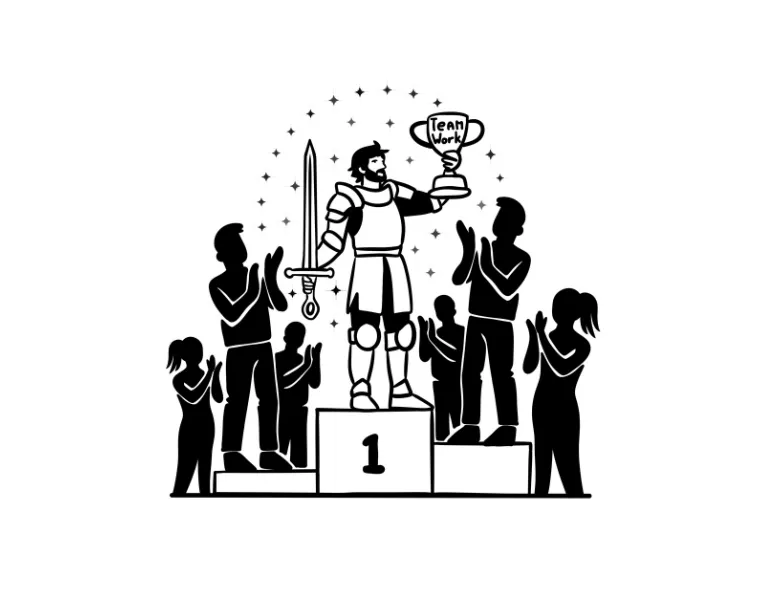
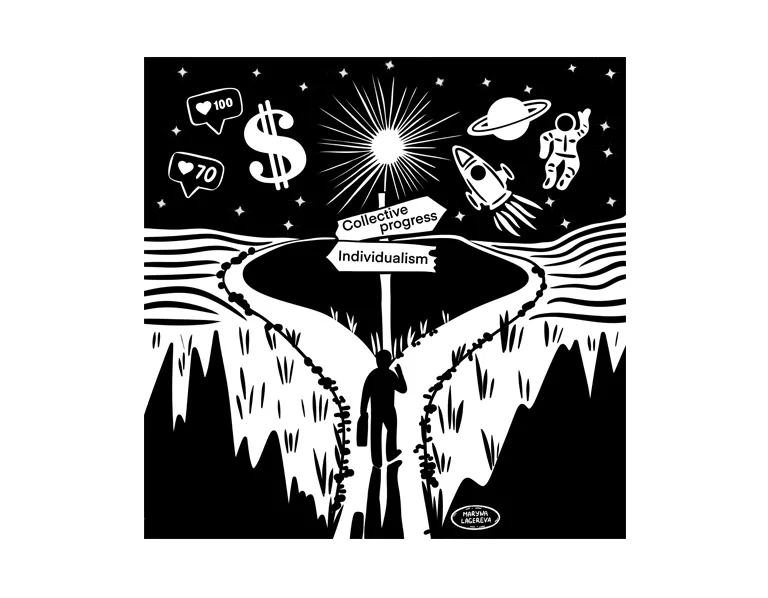
Humanity’s history is short compared to the age of the universe, but it has gone through distinct phases of collective effort and of individual pursuit. There was a time when people united behind common causes: empires, explorations, great feats of architecture like the aqueducts, or knowledge advanced for the benefit of all. Whole societies achieved those things together, each person contributing to something bigger than themselves. Today, the focus has shifted sharply towards the individual.
Heroism used to be rooted in a collective spirit, in exploring unknown territory and pushing back the limits of shared knowledge. It has become something more inward-looking. Personal achievement, self-expression, and individual success now dominate our culture. Social media and the ultra-personalization of our experiences have put the spotlight on the individual rather than the collective.
Where does this leave us? Are we losing sight of the big projects that once defined our progress? There are challenges ahead that need the same kind of collective effort, especially if we think about our future survival and reaching for the stars.
Collective Heroism in History: The Power of Shared Ambitions
Earlier in human history, heroism was often tied to the collective. It wasn’t about individual glory but about being part of something larger. Ancient Greece, for instance, celebrated its heroes as much for what they represented for their cities and their people as for their personal achievements. The Olympic Games were more than competitions. They were a display of shared pride and of the strength of the city-states. In Rome, likewise, being a “citizen” carried a sense of duty and a commitment to the grandeur of the empire.
Collective heroism led to projects that seemed almost impossible, like the Roman aqueducts, massive undertakings on which the survival and well-being of entire populations depended. They are still awe-inspiring today. And yes, many of these monumental projects were built by the labor of people who had little choice but to serve.
Broad trends are useful, but history is rarely that simple. Take the Renaissance, a period celebrated for its collective cultural progress and the flourishing of art, science, and philosophy. It also saw the extraordinary work of individual geniuses like Leonardo da Vinci and Michelangelo.
These figures were models of personal excellence, and they also inspired collaborative work that pushed the boundaries of human achievement. Their talents complemented the collective spirit and showed that individual brilliance and communal progress are not mutually exclusive. The two can coexist, and society is richer for it.
People were motivated by their personal desires, but also by a sense of shared destiny. That common purpose made possible achievements no individual could have managed alone.
The Rise of Individualism: Shifting Priorities
The shift from collective heroism to individualism didn’t happen overnight. The Industrial Revolution started it, as people moved from rural, community-centric lives to urban centers where individual economic success became the focus. The trend continued as capitalism and consumer culture took hold. In that world, self-worth was increasingly tied to individual accomplishments and personal fulfillment.
The shift grew more pronounced over time, especially following the traumas of the 20th century. After World War II, society moved toward a model focused on individual fulfillment. This can be seen, in part, as a response to the failure of collective ideologies like fascism and communism, which led to immense human suffering. In the aftermath, personal freedom and happiness gained ground, and people became wary of large-scale collective movements.
The rise of neoliberalism from the 1980s onwards accelerated the trend further. The dominant narratives shifted from collective solidarity to individual success, and the emphasis from shared prosperity to personal achievement, to being able to “make it” on one’s own terms.
Technology, especially since the arrival of social media, has amplified individualism further. Algorithms cater to each person’s tastes, habits, and opinions, and build echo chambers that reinforce personal perspectives. With hyper-personalization, even shared cultural experiences now reach us filtered through individual preference.
It’s no longer about participating in a collective story, it’s about curating a personal one.
The Consequences of Individualism
The move towards individualism has brought undeniable progress. Personal freedoms have expanded, and people are, in many ways, freer to be themselves. But this focus on the self has come at a cost. We’re seeing a decline in the sense of shared responsibility, which used to be fundamental to the survival and growth of societies. With people focused mainly on their own lives, the idea of contributing to a greater collective purpose has faded.
One consequence is the weakening of social cohesion. As communities become more fragmented and the emphasis on personal success intensifies, feelings of isolation and loneliness have grown.
The research here is narrower than the slogan, and I would rather state it precisely than borrow its authority. A multinational study across 28 countries, covering 8,345 people, found that those who scored high on vertical individualism, the competitive kind that values standing out and getting ahead, reported more loneliness, while those who valued egalitarian social ties reported less. The effect is real but small, and it links values to self-reported loneliness. It does not prove that a culture makes its people depressed. That is enough for the argument I am making, and I would rather not stretch it further.
The constant comparison that social media encourages makes these problems worse, as people measure their worth against curated portrayals of others’ lives. This shift undermines social cohesion, and it erodes the support networks that mental well-being depends on.
The shift is visible in politics too. Debates are increasingly framed around individual rights and freedoms instead of common solutions, often at the expense of collective well-being. The current situation is all the more worrying because it can become fertile ground for extremist ideologies and strengthen convictions that lead to uprisings or even authoritarian regimes. History has shown what could happen.
The fragmentation extends to our very perception of reality. Digital media and personalized content create isolated bubbles where people only engage with information that fits their worldview. This has made it harder to face challenges as a unified society, because there is less common ground to begin with. The shared vision that once propelled entire nations toward greatness has given way to a multitude of smaller, conflicting goals, each tailored to individual desires.
The Future: Human Survival and Space Exploration
Technological progress is about more than convenience or innovation now. The survival of the human species depends on it. I’d argue that our future, as an inherently expansionist species, lies in the stars. To me, the conquest of space is the natural extension of our curiosity and our desire to explore new frontiers.
For centuries, humanity has dreamed of exploring space. Long before the first rockets left the ground, people would look up at the night sky and wonder what it would be like to journey among the stars. This collective dream spans hundreds, even thousands of years, yet today it seems to be fading, smothered by the growing focus on individualism. The desire to push the limits of human existence is dwindling, crowded out by immediate personal concerns and the narrow horizon of short-term politics.
Space exploration requires a unified vision and collective investment, an effort bigger than personal gain and passing interests. It’s not something a single individual or even a single country can achieve alone. It needs the kind of collaboration, funding, and shared ambition that once built empires or forged global alliances.
Few people today rank ambitions on that scale as a priority, and with enthusiasm this low, our ability to move beyond our planet is in serious danger.
A goal this monumental requires a commitment to building infrastructure, advancing shared knowledge, and providing good education and a decent quality of life. It would also require a rework of our culture, one where students are encouraged to pursue goals that contribute to national, and even global, progress, and where a meaningful career means having something to achieve for Humanity.
The International Space Station (ISS) shows what nations can accomplish when they come together with a shared vision. The orbiting laboratory is a marvel of international collaboration, with contributions from NASA, Roscosmos, ESA, JAXA, and CSA, among others. The global response to climate change is another example of positive collectivism, with countries uniting against a common threat through treaties like the Paris Agreement, even after the United States left it in January 2026. Community efforts in a crisis are a third, like the rapid mobilization of volunteers and resources after a natural disaster. They show that collective action can lead to outcomes that are both effective and compassionate.
Can We Rediscover a Collective Spirit?
The question we face now is whether we can revive that kind of collective spirit in an age increasingly focused on the individual. To reconcile individualism with shared ambitions, we might need to reshape our narratives and move from the pursuit of personal success to the pursuit of a larger, shared dream, like space exploration.
Suppose that, instead of viewing each other as competitors, we saw ourselves as partners in a grand project to take humanity beyond Earth. That shift in mindset would require major educational reforms, global cooperation, and perhaps even financial policies that invest directly in a shared future.
So the real question isn’t whether we still dream of the stars, but whether we can still do anything together big enough to reach them. Can a culture this good at celebrating the individual still rally around a project none of us could finish alone?