Europe burned again this summer. By mid-August, the area burned in the EU had passed half a million hectares, well above the long-term average according to Copernicus EFFIS data, and all of it in the shadow of 2025, the worst season on record at over a million hectares. In late July, France’s interior minister said the country was fighting 30 to 40 wildfires every single day, while the Gironde burned through the largest French fire since 1949. Behind the statistics, the same choreography every time: evacuations, exhausted crews, aircraft grounded by wind, and a fire that simply does not care.
What we talk about less is that fire is the cheapest weapon there is. A box of matches against a fleet of water bombers. This is not a hypothetical. During World War II, Japan launched some 9,000 incendiary balloons, the Fu-Go program, across the Pacific with the explicit goal of setting American forests alight. In a world of drones and proxy conflicts, a landscape this dry is not just a natural disaster waiting to happen. It is a target. Arson as guerrilla warfare does not need technology, only intent and a dry summer.
I wrote a while back about Asimov, Foundation, and the personal force shield, the kind of object science fiction plants in your head decades before physics catches up, if it ever does. This essay is my attempt at the same game. Watching this summer unfold, the device I kept imagining was simple to say and absurd to build: a storm you can order. Not weather control, not sunshine on demand. One storm, one place, one purpose.
What We Already Know How to Do
When I dug in, the surprise was that the impossible part is smaller than it looks. Cloud seeding has existed since 1946, when Vincent Schaefer at General Electric first coaxed precipitation out of a cloud. Disperse silver iodide into an existing cloud and you can nudge it into raining. China runs a massive weather modification program and famously used it around the Beijing 2008 Olympics. The United Arab Emirates has flown drones that zap clouds with electric charge to encourage rain. And two days after I published this essay, a California startup called Rainmaker went further, using two autonomous drones and 374 grams of silver iodide for a claimed 71,000 cubic metres of rain over Alaska in three hours. Read the caveat with the claim, though, because it is the same caveat this whole essay lives under. They did not seed one cloud and leave an identical one alone, and the clouds were already raining, so the number is an estimate of a nudge rather than a measurement of a storm. Pushing a cloud is a solved problem, more or less.
What nobody can do is create a storm from nothing. A thunderstorm needs three ingredients: moisture, atmospheric instability, and a lifting mechanism. The energy involved is beyond any machine we could plausibly build. And the cruel joke of megafires is that they strike exactly when the air is desperately dry. There is nothing to seed.
Except. A big enough wildfire builds its own lifting mechanism, a convection column so violent it can punch into the upper atmosphere. Fire crews already know the nightmare version of this, the pyrocumulonimbus, a storm cloud born from the fire itself, sometimes throwing dry lightning that starts new fires downrange. The fire already brews its own storm. Two of the three ingredients come free. The only thing missing is water.
How to Bottle a Storm
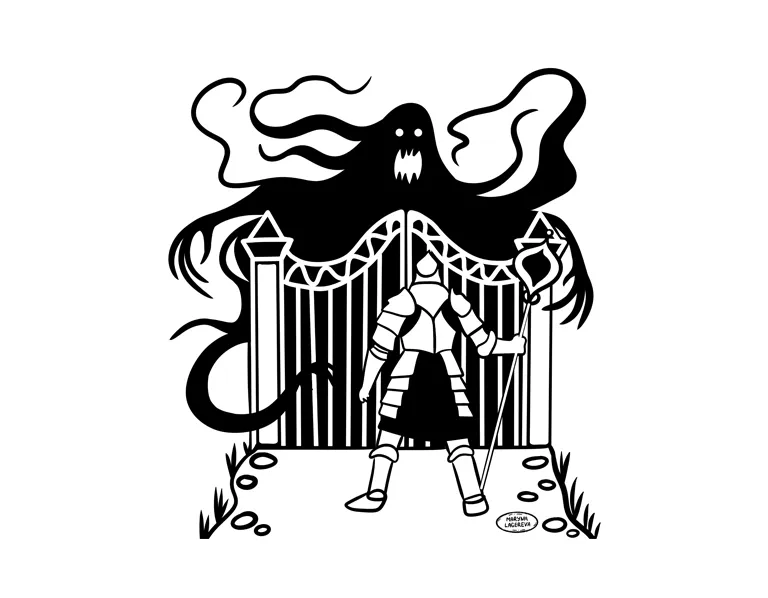
So here is the machine. A crown of pylons, dropped like darts from heavy helicopters and drone swarms, planting themselves in a wide ellipse around the fire, offset downwind, encircling not where the fire is but where it is going (which is how firefighters place containment lines today, except this line stands up). Each pylon meshes an energy field with its neighbors. The crown closes segment by segment. No roof. The cage is an open cylinder, because the fire’s chimney is the engine we need. It lifts the water we inject, we seed the top, and the fire is forced to brew its own extinguishing rain. The storm is the lid.
The Simpsons delivered their dome by helicopter to trap a town. Ours traps a disaster. Same image, opposite morality.
The wall itself is a ladder from real to speculative. At the bottom is plain physics. The pylons are lightning rods, draining the artificial storm’s strikes so they cannot start new fires. One rung up comes an industrial trick. The wall’s upper lip tilts inward like a chimney cowl and runs a curtain of charged mist, a giant wet scrubber, the same technology factories use to wash particulates out of flue gas. Hot gases pass, heavy firebrands get caught and drop back inside. The chimney keeps its engine but loses its ammunition. Higher still, the mist curtain itself, recharged by water bombers that no longer drop on the flames but on the wall.
And at the top of the ladder sits the leap I fully admit, a field that contains radiant heat and wind at kilometer scale. The germ is real. A flame is a weakly ionized plasma, DARPA showed over a decade ago that small flames can be bent and snuffed with electric fields, and Boeing even patented a laser-induced plasma shield against blast waves in 2015. But the scale-up is pure science fiction. That is the price of admission, and I am paying it openly.
Wind is the obvious killer, and the two best answers are entirely passive. The first is a skirt, an outer ring of low, porous windbreak panels, planted by the same dart logistics. Solid walls make terrible windbreaks, because they spawn violent eddies right behind them. Porous ones bleed the flow and shelter a strip many times their own height, a trick farmers and snow-fence builders have relied on for generations. The second is borrowed from the spiral strakes on industrial chimneys. The field curtain is ribbed in a helix, so a tall cylinder does not shake itself apart in the wind. Above those, a profiled windward face vaults the surviving flow up and over the cage, and a control loop shifts power between segments as sensors read the load. Not an AI, on purpose. An institution that cages storms wants decisions that are deterministic and auditable in court. The wall is dumb by design.
The order of operations is doctrine, not detail. Sweep the zone. Plant the crown. Preload: water bombers inject moisture into the column while the ring is still open. Seal. Seed. Storm. Mop-up, because rain never kills the deep embers. Human crews still walk in last.
Two rules hold it together. Water first, because sealing a dry superheated chimney builds the perfect firebrand launcher. And no seed without seal, because an unconfined artificial storm is precisely the thing that killed 19 firefighters at Yarnell Hill in 2013, when a natural storm’s outflow turned the fire on them in minutes. The cage is not an accessory to the storm. It is the only thing that makes the storm legal.
The Storm Department
Legal is the right word, because the trigger question is nastier than the physics. Your storm steals your neighbor’s rain. Weather does not recognize borders. There is already, astonishingly, a treaty for this. ENMOD, signed in 1977, bans environmental modification as a weapon. The institution almost writes itself. A dual key, borrowed from nuclear doctrine, means the host country requests and a treaty authority authorizes. The EU already pools firefighting aircraft through rescEU. Extrapolate that into a planetary Storm Authority with prepositioned regional depots, wheels up in 6 hours, crown sealed in 24-48. The inside of the cage becomes the only volume on Earth where triggering a storm is lawful.
And the human protocol is where the weight lives. The sweep is a phase of its own: thermal drones, cell network pings, mandatory evacuation, and a crown that closes progressively, keeping the final segment open as an exit corridor. The last door. Somewhere in this system there is a sealing officer whose signature closes it, and who has to live with the fact that no sweep ever reaches certainty. Max Weber defined the state by its monopoly on legitimate violence. The Storm Authority extends that to a monopoly on legitimate weather. Put another way, and this is the quiet part, a machine that makes storms is a weapon that makes storms. That is why it gets caged twice, once in fields, once in institutions.
While I was writing this, the institutional half stopped being hypothetical. Rainmaker notified the state of Alaska and skipped the town. Within days a state representative was demanding a cease-and-desist, and the borough mayor was explaining, publicly, that nobody had told him. Seventy thousand cubic metres of rain, made privately over somebody’s home, was enough to produce the crisis of legitimacy this section is about. Multiply that by a caged megafire and you see why the sealing officer needs a signature, a mandate, and a phone number the mayor already has.
One guardrail before anyone gets excited. Critics already argue that Europe pours money into fighting fires and almost none into preventing them. A working storm cage would make that moral hazard worse. Why manage forests when you can bottle the consequences? If this thing ever exists, its budget should be legally chained to a prevention budget twice its size. The cage is a tourniquet, not a cure.
Someone Else’s Essay
I know what remains broken. Helicopters still cannot fly in the winds that drive the worst fires, so the machine that tames weather still waits on weather. There is a night in every version of this story where the wind exceeds the spec and the crown stays in its depot. That problem belongs to someone else’s essay, and honestly, to someone else’s century.
Asimov’s personal shield made individual violence pointless, and Foundation spent a thousand pages exploring what that does to power. A storm in a cage would make wildfire, one of humanity’s oldest terrors and newest weapons, into something a bureaucracy schedules. This is an essay, not an idea, because nobody builds this from a garage.
In the spirit of this site, I will offer one exception. The skirt stands alone. A dumb, porous windbreak ring that fire crews could deploy tomorrow needs no plasma and no treaty. If you start there, tell me.
So here is what I keep turning over. If we ever hold the keys to one commanded storm, who do you trust to turn them, and what do we stop taking care of the day it works?