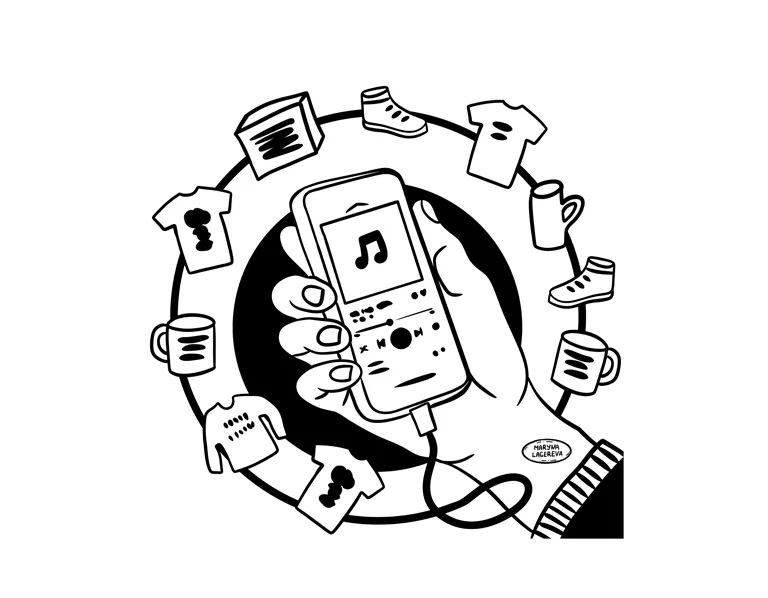
Of all the ideas on this site, this is the one I actually built. Not sketched, not briefed. Built. EmoTune started in 2023 as a simple conviction, that we look for music by artist, genre, and era, when what we usually want is a feeling. I wired it up as a layer on top of Spotify. You logged in with your account, let the app read the emotional profile of tracks, and asked for what you wanted to feel instead of what you wanted to hear. The demos were good. Friends tried them and got playlists that landed.
Then I hit the wall, and the wall kept growing. Spotify’s public API grew steadily more restricted and more complex to build against, and in late 2024 the platform deprecated, for new third-party apps, the endpoints an app like this breathes through: the audio features that exposed a track’s energy and mood characteristics, the audio analysis, the recommendation engine. My abandoned prototype was not a failure of nerve or of code. The ground it stood on was repossessed. That story is worth an article on its own, so here is the idea in full, what killed it, and the version that deserves to live anyway.
The concept has not aged a day. You open EmoTune and, instead of a search bar, you are offered a spectrum. Not a crude “happy” button (that was my first design mistake, corrected early), but a range of nuanced states: calm, energized, melancholic, inspired, nostalgic, defiant. Next to it, an intensity slider, because “energized” at two out of ten is a bright pop song and at nine it is a wall of drums. Over time the app learns your personal emotional map, because what sounds melancholic to you and to me may be different songs, and that personalization, not the labels, is the real product.
The parable: killed twice by the same platform
EmoTune died two deaths, and both are instructive for anyone building on someone else’s platform.
The first death was absorption. While I was prototyping, Spotify shipped its own contextual mood curation, daylists that shift with your day, mood-tagged editorial everywhere. The platform looked at the same user desire I saw and folded a version of it into the core product. That is the first law of building on a platform: any feature valuable enough to build is valuable enough for the host to build without you.
The second death was the door closing. The late-2024 API deprecations did not target me personally, but they ended the category. An entire generation of stats apps, mood tools, and discovery experiments lost access to the analysis data they were built on, and new apps could not get it at all. That is the second law: an API is not infrastructure, it is a favor, revocable at any time, and a business built on a favor is a tenant, not an owner.
I am not bitter about either law. Platforms owe outsiders nothing. But I watched both laws execute on a working prototype, and the lesson is now load-bearing in the version below.
Key Features
- The emotion spectrum. A curated range of feeling-states, deliberately richer than the five moods of editorial playlists, as the primary way in. You browse feelings, not genres.
- The intensity slider. The feature I remain proudest of: every emotion has a volume knob, and the pair (feeling, intensity) maps to concrete musical parameters. It turns a vague mood into a precise request.
- A personal emotion profile. The app learns from what you keep, skip, and repeat within each emotional context, building a private map of what actually moves you. The labels start generic; the profile makes them yours.
- Context, gently. Time of day and season can pre-tint suggestions, a calm Sunday morning defaults differently than a Friday night, always as a suggestion, never as a cage.
- Exploration, gamified with restraint. My 2023 notes said “make it almost addictive,” and older me wants to edit younger me: no leaderboards, no streaks guilt. What survives is the good part, gentle rewards for exploring the map, a badge for venturing into emotional territories you never visit, a weekly nudge toward one unfamiliar feeling. Design for curiosity, not compulsion.
- Emerging artists as the center, not the garnish. My original plan sprinkled a quota of unknown artists into playlists. The rebuilt version inverts that entirely, and the next section explains why that inversion is what saves the whole idea.
The version that survives: leave Spotify entirely
Here is the pivot that turns both platform deaths into a mission. If the closed catalog will not let you analyze it, build on the music that wants to be analyzed: open-licensed catalogs, independent distribution platforms, and artists who opt in directly. The analysis layer no longer needs anyone’s API. Open-source audio analysis toolkits can extract energy, tempo, timbre, and mood-correlated features from any track you have the right to process. The stack that was a favor becomes a stack you own.
And suddenly the weakness is the positioning. EmoTune cannot be “Spotify, but emotional,” because the door is closed. It can be something better, the discovery engine for the vast, growing world of independent music that mainstream algorithms bury. An unknown artist’s track surfaces there because it matches what “nostalgic, intensity six” feels like, not because a popularity flywheel chose it. Emerging musicians get something they cannot buy, a discovery path that ignores fame entirely. Listeners get music they could not have found. Nobody’s API can take that away, because the catalog’s whole premise is permission.
The honest tensions
Emotion detection is crude, and the article should say so plainly. Musical emotion is personal and cultural. A model tagging a track “melancholic” is making a statistical guess about averages, and it will be wrong for you regularly. EmoTune’s defense lies in its architecture. The global labels are only a starting grid, and the per-user profile, learned from your actual behavior, does the fine-tuning. An app that pretended the labels were truth would deserve its bad reviews.
The wellness line must be walked carefully. An emotion app will be tempted to market itself as mental-health adjacent (my old notes even suggested mental-health influencer partnerships), and that temptation should be resisted in writing. EmoTune curates moods, it does not treat them. No therapeutic claims, no “scientifically proven to reduce anxiety,” nothing the concept cannot support. Music affects how we feel. That observation is enough, and overclaiming it is both dishonest and, in some jurisdictions, regulated.
And the catalog gap is real. Leaving Spotify means losing the songs people already love, which stings on day one. The bet is that emotion-first discovery is exactly the mode where not knowing any of the artists is acceptable, even desirable. Nostalgia for your own library needs Spotify, but discovery of your next favorite unknown does not.
Monetization
The free tier has the spectrum and daily discovery, and a modest listener subscription unlocks the full profile, offline mixes, and unlimited exploration. On the artist side, one red line and one open door. The red line is that artists never pay for placement, because an emotion engine that sells its feelings is a payola scheme with extra steps. The open door is analytics. Artists and indie platforms can pay to see how their music lands emotionally, with which audiences, at what intensities. They cannot get that knowledge anywhere else, and selling it does not corrupt the listener side. If the engine gets very good, licensing the emotion-mapping layer to indie distribution platforms is the B2B future.
Next Steps: How I’d Build It
Start with a few hundred tracks from open catalogs, run the open-source analysis stack over them, and rebuild the demo I already had (spectrum, slider, and a first crude map). I have the advantage of having done this once. The UX questions are already answered in my old prototype, and the parts that died were never the parts I built.
Then grow the catalog through artist opt-in, ship the personal profile, and treat the emotion labels as a living, versioned model rather than a truth. The hard parts are the cold catalog (solved by mission, starting with one scene or one label that wants this), the label quality (solved by iteration and user correction), and the discipline to keep the wellness marketing honest when growth gets tempting.
Closing
EmoTune is the idea I built, lost to two laws of platform gravity, and still believe in, now rerouted through the one catalog that cannot evict it. It shares blood with WaveArt, another of the music ideas on this site. Both start from the conviction that a song is an emotional object first and a file second.
If you build this, tell me, and I will happily compare your prototype with the ghost of mine. And if you are an independent artist reading this, you are not the garnish in this idea. You are the reason it survives.