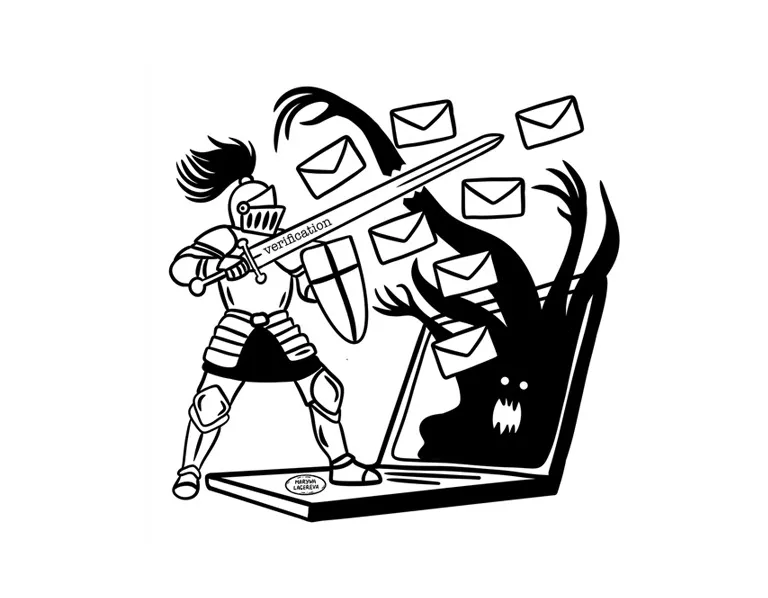
This one did not arrive as a product idea. It arrived as a worry. Late one night I found myself dictating a long, rambling message to an AI about something that had been gnawing at me. It was the feeling that scientific thinking itself, the basic shared agreement that evidence beats assertion, was losing ground. Not in one place, not on one topic, but as a slow tide across medicine, education, and public life. I asked the machine a simple question: can this be made visible?
There is a famous precedent for making dread visible. In 1947 the Bulletin of the Atomic Scientists compressed the entire nuclear age into a single image: a clock face, a few minutes before midnight. No dashboard, no report, just a hand that moves. In January 2026 they set it at 85 seconds to midnight, the closest it has ever stood. Seventy-nine years on, that one image still does more work than a thousand white papers.
So here is the idea, whole. The Obscurantism Clock is the same device, pointed at a different danger. A public clock that answers one question, how far are we drifting from scientific thinking, using a transparent formula, weighted indicators, and data anyone can trace back to its source. Midnight is the point where evidence stops mattering. The hand moves when the indicators move.
And whether or not the popular story of eight dark medieval centuries is entirely fair to the scholars who lived through them, the fear that story names is real. Knowledge can go backwards. It has before. A clock is a way of watching for it.
What the verified data actually says
This concept only works if its numbers are unimpeachable, so before writing this article I had every headline statistic in my original draft fact-checked against primary sources. Here is what survives, and it is sobering enough without any embellishment.
Trust took real damage. Pew Research Center’s long-running series shows the share of Americans with a great deal of confidence in scientists falling from 39% in April 2020 to 23% by late 2023. A JAMA Network Open study of more than 440,000 US adults (Perlis et al., 2024) found trust in physicians and hospitals dropped from 71.5% in April 2020 to 40.1% by January 2024. The consequences are not abstract. The CDC recorded roughly 2,288 confirmed measles cases in 2025, the most in any year since 1991 and the largest outbreak since the disease was declared eliminated in 2000, while kindergarten vaccination exemptions hit a record 3.6%. Pew finds support for school MMR requirements fell from 82% in 2019 to 69% in 2025.
The divide is now tribal. Pew measures a 25-point partisan gap in confidence in scientists, and the share of Republicans with little or no confidence nearly tripled between April 2020 and late 2023, from 14% to 38%. A 2024 University of Michigan study in Scientific Reports, analyzing millions of tweets, estimated that 14.8% of Americans deny climate change, with denial topping 20% in four states, and identified Donald Trump as the strongest single influencer in that denial network, ahead of conservative media outlets. On the education front, PEN America has documented nearly 23,000 school book bans across 45 states since 2021, alongside 51 enacted state laws or policies restricting classroom instruction. And the mechanics favor the wrong side. The landmark Vosoughi study in Science found false news on Twitter reached its first 1,500 people about six times faster than true news.
But, and a clock worth trusting must show this too, the freefall is not the whole story. By late 2025 Pew measured confidence in scientists ticking back up, with 77% of Americans expressing at least a fair amount. The sharp collapse happened between 2020 and 2023. The story since is less a plunge than a hardened, polarized plateau. Any instrument that can only move toward midnight is a marketing campaign, not a measurement. This clock’s hand must be able to move backward, and as of today, it slightly would.
Key Features
- A formula you can audit. A weighted sum of public indicators maps to a score from 0 to 100, and the score maps to minutes before midnight. The whole computation is a page of open-source JavaScript, published on the site. No black box, no vibes.
- Every number wears its source. Each indicator links to the primary institution that produced it (Pew, CDC, PEN America, peer-reviewed journals), with the survey date and a permanent archive copy. If a number cannot be traced, it does not enter the formula.
- An events ledger. Major documented events, an outbreak, a landmark law, a major institutional restructuring, are logged with dates, sources, and their computed effect on the score, so anyone can replay history and see why the hand moved.
- A hand that moves both ways. When the data improves, the clock retreats from midnight, publicly and with the same fanfare. This is the feature that separates an instrument from a doom machine.
- Honest measurement labels. Survey data, social-media-inferred estimates, and case counts are different kinds of knowledge. The clock displays them in separate tiers rather than blending a 2019 Twitter analysis into a 2025 poll as if they were the same thing.
- Open data and an embeddable widget. The full dataset ships as JSON under an open license, and any site can embed the clock, the same way the Doomsday Clock spreads through citation.
How it stays honest
The uncomfortable truth about any index like this is that the weights are a judgment call. Why should vaccine hesitancy count for more than book bans? There is no equation for that. Someone decides. The Doomsday Clock has the same property, and the Bulletin handles it the only defensible way, by owning it. A named, diverse board deliberates in public, publishes its reasoning, and accepts the argument. The Obscurantism Clock should copy that honesty rather than hide behind decimals.
So the false precision of a readout like 23:47 is a rhetorical device, and the site should say so, plainly, on its methodology page. The clock is a communication instrument built on real data, not a physical constant. Its credibility budget is spent in one place, on never publishing a number that cannot survive a hostile fact-check. A small editorial committee spanning disciplines and, above all, political sensibilities reviews every indicator change, and dissents get published too. The project critiques systems and incentives, never private individuals. Where a public figure appears, it is because a peer-reviewed study put them there, cited verbatim.
Monetization
This is a civic project, not a business, and pretending otherwise would poison it. The MVP costs about as much as a domain name, roughly 15 dollars, because a static site on free hosting needs nothing else. Sustaining it looks like donations, foundation grants in the science-literacy and press-freedom space, and university partnerships that lend both rigor and credibility. No ads, no paywall, no dark patterns. An instrument about trust cannot fund itself by eroding it. If it ever earns anything, it is through sponsored access to a clean historical API for newsrooms and researchers, priced to cover servers, not to profit.
Next Steps: How I’d Build It
The build is the easy part, and I mean that literally: a static site, one JSON file of indicators, one JSON file of events, an animated SVG clock face, and the scoring function, deployable on GitHub Pages in two or three weeks by one person. The Plotly charts and the widget come right after. None of this is the hard part.
The hard part is governance, and it starts before the first commit. Recruit the small editorial committee first, agree on the indicator list and the weights in writing, and publish that methodology page before publishing any score. A clock that appears fully formed from one anonymous author is exactly as trustworthy as it sounds. The second hard part is the fact-check-first rule as an operating principle. Every indicator update is verified against the primary source, archived, and only then merged. Slower, and worth it.
And the third is the obvious one. The accusation of political bias will arrive within hours of launch. The only defense that works is radical transparency, indicators from recognized scientific institutions only, methodology public, code open, committee politically diverse, and the hand demonstrably willing to move away from midnight when the data says so. You will not convince everyone. The narrower, more achievable goal is that any good-faith reader who checks the sources finds exactly what the clock claims, every single time.
Bonus: the first draft failed its own test
I owe you a confession, because it is the best argument for building this. The first draft of this concept, produced in that late-night AI conversation, came loaded with statistics. Some checked out. Several of the most alarming ones did not. A dramatic collapse of strong confidence in science from 32% to 8%? No such numbers exist in any primary source; the real Pew series shows decline, then a modest recovery. A rise in parental vaccine distrust from 6% to 27%? Unsupported; the real Pew figures tell a related but different story. Meanwhile the measles count in the draft was actually lower than the grim reality.
Think about what happened there: an AI, asked to document the erosion of truth, invented evidence for it. Fluent, plausible, sourced-looking evidence. If I had shipped that draft, the first hostile fact-check would have deservedly killed the project, and the debunking would have become one more data point for the very cynicism the clock is meant to measure. The clock’s first act was to fact-check itself, and it barely passed. That experience is now its founding rule, and it is a rule this whole era could use.
Closing
The Obscurantism Clock is one image for a diffuse dread, built on data that survives being checked, honest about its judgments, and capable of delivering good news. The concept, the methodology, and the roadmap are all yours under the same open license as everything here.
If you build this, tell me. I want to be there the first time the hand moves, in either direction. And if you want help pressure-testing the methodology before launch, that is the part I care about most, so ask.