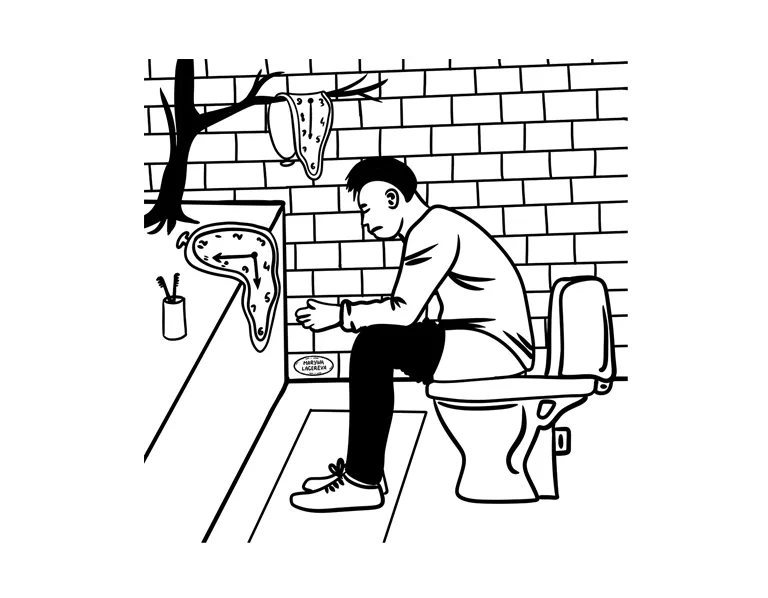
Have you ever been in the middle of a bathroom break, secretly timing yourself, wondering if today you’ve set a new “personal best”? As a guy, I’ve had this thought more than once. Some sessions clock in at a surprising 45 seconds or more, and I’m left wondering, “Was that my longest yet?” But there’s no easy way to track these things, until now.
The device is a small, colorful box that sits above the toilet. A sensor starts the timer when you walk in and stops it when you leave, so the tally arrives without you touching anything. The machine is that simple.
The second function, and the one I would actually keep, is a beep after ten minutes. Not a health feature, a nudge. It is far too easy to lose a quarter of an hour to a feed while sitting somewhere you meant to be for two minutes, and a small noise in the room is a better interruption than a notification on the phone that is causing the problem.
And for those of us who like a stupid comparison, there is a leaderboard to share with friends who are up for it.
Add it up and you get a number, a nudge, and a bit of friendly competition, in a box that is as colorful as it is unnecessary.
Market & Opportunities
People already count their steps, their sleep and their coffee. Counting this is the same reflex pointed at the one room nobody instruments, which is why it is funny.
Who buys it? Someone who already owns a silly gadget, and someone buying a gift for the friend who is famously never out of the bathroom. This is an impulse purchase and a Secret Santa object. I will not pretend there is a wellness market waiting for it.
There is one non-joke behind the ten-minute beep, and it turned up after I first wrote this. A 2025 study in PLOS One surveyed 125 adults before a colonoscopy and found that people who used a smartphone on the toilet were far more likely to stay more than five minutes (37% against 7%), and had a 46% higher rate of hemorrhoids. The authors are careful and so am I: it is a small, cross-sectional study on people over 45, it relies on what they said about themselves, and it cannot show that the phone caused anything.
So no, this is not a medical device and I am not selling one. But it does mean the beep is aimed at something real, and that is a better reason for a joke gadget to exist than a market trend.
Key Features
- It starts on its own. A presence sensor begins the count when you walk in and stops it when you leave. No button to press, because a tracker you have to remember to start is a tracker nobody uses.
- Two big buttons anyway. For the people who would rather run it by hand, and because two large colorful buttons on top are half the charm of the object.
- A clock the rest of the time. Idle, the display is just a bathroom clock. It has to earn its place on the wall during the twenty-three hours it is not counting anything.
- The ten-minute beep. Optional, configurable, off if you want. A noise in the room beats a notification on the device that is keeping you there.
- A leaderboard you have to opt into. Invite-only groups with friends or family, nothing public, nothing shared by default. The stat is funny among people who chose to see it and creepy everywhere else.
A companion app can come later for trends over weeks. What it should not collect is anything that turns a joke into a medical record: no hydration logs, no symptom tracking, no “restroom routine” data. The device counts seconds, and it promises nothing more.
Monetization
Sell the box. That is the business, and for a gift object at an impulse price it is very nearly the whole business. A two-pack for households with two bathrooms is the only bundle I would bother printing.
Everything else is optional and small. The app can sell a few sounds and themes, because people will pay a euro for a fanfare. I would keep the trends and the leaderboard free, since they are the only reason to open the app twice.
What I would refuse is the wellness partnership. The moment this thing recommends a hydration supplement or a bladder-health brand, it stops being a joke about a stopwatch and starts being a health product that has to answer for its claims. There is no version of that I would want to defend, and the margin on a sachet is not worth it.
Next Steps: How I’d Build It
Do not manufacture anything. The first version is a presence sensor, a microcontroller and a 3D-printed shell, taped above one toilet, in one flat, for a month. It costs almost nothing and it answers the only question that matters: do you still look at the number after two weeks, or did you laugh twice and stop? A gag object lives or dies on that, and no amount of industrial design saves it if the answer is no.
If you still look, the walls are the ordinary hardware ones, and they are worse than they sound for an object this cheap. Small-run injection molds cost more than the whole first batch will earn. A bathroom is a humid room, so the enclosure has to be sealed and the thing has to run for months on a battery or accept living next to a socket that may not exist. And an electronic device sold to consumers needs CE or FCC marking, which is a real line in the budget of a joke.
The sensor itself is the fiddly part. Telling a real visit from someone walking past to grab a towel is the difference between a funny number and a broken one. Start with the crudest thing that works, and only add cleverness once the crude version is wrong often enough to annoy you.
Then price it honestly. If the bill of materials plus certification means the box has to sell for the price of a decent dinner, it is no longer an impulse buy and the idea quietly dies. Better to find that out with a taped-up prototype than after the molds.
Bonus: the one misuse that matters
A sensor on a bathroom wall is a surveillance device wearing a joke.
The risk is not theoretical. The same box that tells you your own number tells a parent how long a teenager was in there, or a manager how long an employee was gone.
So the design has to refuse that job. No named profiles on the device, no history a second person can pull up, no export of someone else’s sessions. A shared household box shows the last time and nothing more. If the product cannot be built without a screen that says who was in the bathroom and for how long, it should not be built, and I would rather say that here than discover it in a review.
The rest is ordinary: encrypt what goes to the app, let people delete everything in one tap, and keep the leaderboard opt-in. Bathroom habits are personal even when the whole thing is a gag.
Closing
Chronopiss is a joke I’d use for real. It’s a silly little device that turns an invisible daily ritual into a number, nudges you to put the phone down, and keeps a very stupid leaderboard for friends who are up for it. That’s the pitch, and it doesn’t need to be more than that.
It’s just a concept for now. If you have the hardware chops for the sensor-and-timer version, or the app to go with it, take it and run. You owe me nothing, but if you make a real Chronopiss, send it my way and I’ll happily review it (and time myself with it).