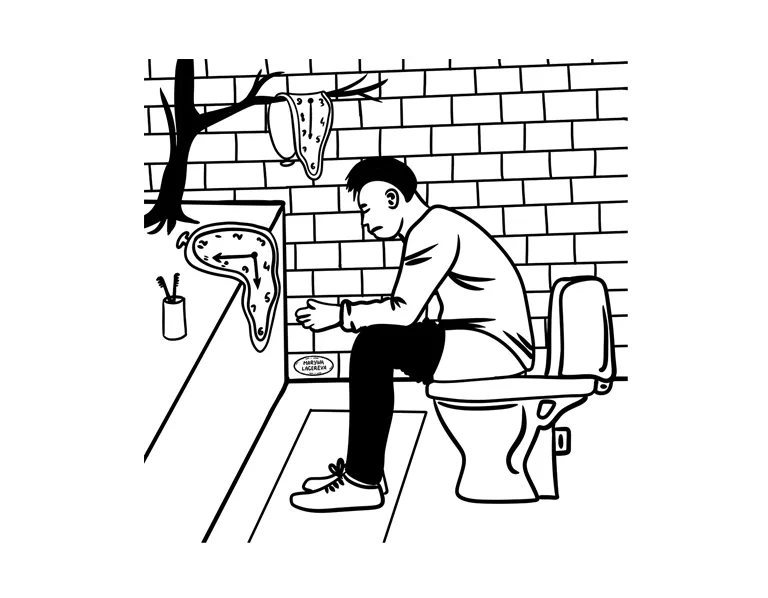
Every workplace has one ritual that would be impossible to explain to an outsider, and ours involved a stopwatch. At some point, in an office I will not name, it became tradition that whenever someone headed for the toilets, somebody else discreetly started a timer. Scores were kept. Records were remembered. And at the end of each month, the colleague at the top of the leaderboard, the reigning champion of the porcelain, paid lunch for everyone. It was completely useless, mildly juvenile, and one of the most reliable sources of collective joy that office ever produced.
I know exactly how I justified it at the time, because I still have the job post I wrote in January 2020, when I decided this ritual deserved software:
Yes, that’s useless and stupid, but it gives us something to laugh about as a group, and a free lunch is always very satisfying.
That job post is its own confession. I budgeted 700 dollars, stated plainly that the project was “totally stupid,” asked for one page, one big chronometer, three buttons and a poop gauge, and posted it under a pseudonym, out of some instinct that my professional name and this project should meet as late as possible. Then a freelancer from the other side of the Atlantic answered, and the story got better than the product.
What Astranus is, and what it is not
Astranus is the office toilet league. A web app where a team, your actual colleagues, tracks sessions on a shared scoreboard: a big timer, a gauge that climbs from a green “relaxed” to a red “stressed” as the seconds pass (half a percent per second, so two hundred seconds to full alarm, a calibration decision I stand behind), personal logs, team stats, a monthly champion, and a newslog that reads like a small-town gazette where every headline is about the same thing. Pseudonyms are first-class citizens, because the leaderboard wants “The Poop King,” not your LinkedIn name, a design point my developer raised himself, with great professional seriousness.
It is not Chronopiss, and the two deserve their border drawn. Chronopiss is a gadget: a box above your own toilet, a number, a nudge, a private habit. Astranus is an institution: teams, seasons, archives, a champion, and a lunch debt. One instruments a bathroom, while the other federates an office. The hardware counts. The league competes.
And one rule sits above all the features, because it is where the joke becomes governance. The monthly champion pays lunch. The game taxes its own winner. It is self-balancing (nobody wants the crown too badly), self-funding (the prize is the group eating together), and self-limiting (the stakes are a sandwich). I have designed payment systems with less elegance than this rule, and I did not even design it. The office did.
The story: 700 dollars, a pandemic, and the most serious man I ever hired
What makes Astranus worth an article rather than a footnote is that I actually built it. Or rather, a freelance developer built it, between January and July 2020, at twenty dollars an hour, and he treated the least serious project I have ever commissioned with the gravity of a banking contract.
He rebuilt the team-join flow until requests resolved in real time with no page refresh, and recorded video tutorials, with his own voice, demonstrating each flow. He moved all timestamps to UTC so that, and I quote the spirit of his update, teammates on different continents would compete on the same time base, a globalization concern for an app with four users. He built yearly archives and defended them. After all, we would not want 2021 to be unable to display 2020’s records, would we? He bought a UI theme out of his own pocket because he believed in the project.
He advised me, with a straight face, to start approaching sponsors, reasoning that if the game got popular, brand representatives should not care what it was about. When soda destroyed his computer, he fought support teams for a week to recover the files and came back apologizing for the delay. Between updates we argued about football. He held strong and correct opinions about underrated free-kick specialists.
All of this happened across the spring of 2020, which is to say through the first lockdowns, two strangers on two continents, checking on each other’s health in every message, building the world’s least essential application while the world shut down. I have shipped far more important software with far less humanity in the process. Somewhere in that contradiction is the entire reason this site exists.
By July the app was, in his estimate, ninety percent done. In August we paused, “just a matter of money,” I wrote, planning to resume in September. The app did not die of failure, or of ridicule, or of technical debt. It died of August, the way most side projects do. Not with a decision, but with a month that quietly became six years.
The honest tensions
One tension towers over the rest, and the league lives or dies on it. The office toilet tracker must never, under any circumstance, be visible to management. A game colleagues play on themselves is joy, but the same data in a dashboard one level up is workplace surveillance with a rocket logo. Astranus is structurally by the team, for the team: opt-in, pseudonymous, data isolated per squad, with nothing exportable and HR permanently uninvited. The lunch rule only works between equals.
The second is the line this site already drew for its sibling. No health claims, none, ever. Chronopiss carries the carefully caveated science. Astranus carries none, because a league does not need a rationale. It is a game. The moment it pretends to be wellness, it becomes both a worse game and a lie.
And the third is honest scale. This is a team-size product, not a network. Its natural unit is one office, five to fifteen people, one running joke. It spreads the way jokes spread, one office telling another at an afterwork, and no other way. There is no venture math here, only a lunch.
Monetization
Barely, and proudly. The core stays free because charging colleagues to laugh together is grim. A small one-time fee per team for the deluxe trimmings (custom gauge themes, the poop-rocket launch animation on new records, printable end-of-season certificates for the champion’s desk). And the true economy of Astranus never touches the app at all. It is denominated in lunches, and the app is merely its central bank.
Next Steps: How I’d Build It
Strangely, this is the one idea on this site where the next step is archaeology. A Firebase project from 2020 exists, ninety percent complete, with team flows, archives, and a working gauge. My engineering assessment is that reviving six-year-old code probably loses to rebuilding it in a weekend with today’s tools, and my personal assessment is that the rebuild matters less than the launch: one office, one month, one lunch actually paid. That was always the missing ten percent, and no framework fixes it.
If I ever do relaunch it, the spec carries over untouched. The big timer, the three buttons, the gauge, the champion, the lunch. Six years of product fashion have not improved on what the office invented by itself.
Closing
Astranus is a stopwatch joke that became a league, a 700-dollar job post that found the most dedicated collaborator of my career, and a ninety-percent-finished monument to the kind of stupid that holds a team together. Somewhere out there is an office that needs this. Statistically, it is probably yours.
If you build this, tell me, and invite me to the launch. I will lose the first month’s championship on purpose, let someone else buy the lunch, and consider every hour of 2020 finally shipped.