This idea comes from years of the same conversation, had over drinks with single friends and lived a little myself. The swipe is broken, and everyone in it knows it is broken. A face gets half a second. The photo decides everything before a single word is exchanged. Matches pile up that nobody ever messages, a drawer of maybes kept for a rainy ego. And the friends who complain the loudest about being judged on their photos will admit, two drinks later, that they judge the same way, because the interface gives them nothing else to judge with.
One evening in early 2024 I started sketching what the opposite would look like, and the answer was not “an app with better photos.” It was an app with no photos at all, where finding out who someone is works the way it does in real life: gradually, mutually, and with permission.
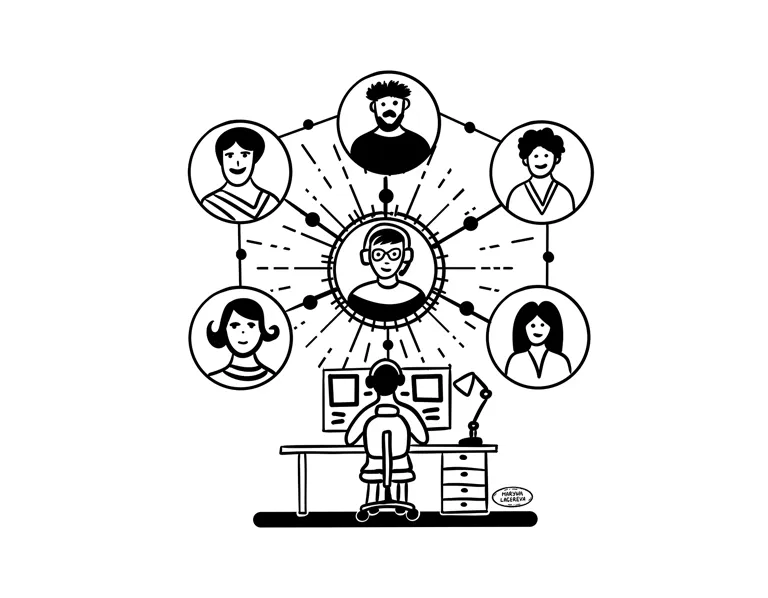
Peel is a dating app built as a stack of layers. A profile starts nearly closed: age range, city, and a first thin slice of who the person is. Everything else (work, passions, values, lifestyle, sense of humor) sits in sections underneath. To see someone’s next layer, you request it. They see your request, and your own visible layers, and they choose to reveal it to you, or not. And the mechanism I care most about is that, at every layer, the interface forces your hand. You request the next section, or you let this person go. No hoarding, no limbo, no drawer of maybes. Curiosity has to be mutual and it has to keep moving, or it ends, cleanly.
Why this might actually work
Three design consequences fall out of the layer mechanic, and together they are the product. First, attention becomes expensive, in the good way. Every reveal is a small mutual yes, so a conversation that reaches layer five means ten explicit acts of interest have already happened, which is ten more than a swipe ever contains. Second, refusal is information. Someone who declines to show you their passions layer has told you something useful, at zero cost to either of you, and you move on without resentment. Third, the superficial signal is simply absent. You cannot judge the photo first, because there is no photo, and by the time faces are exchanged you already know whether the person underneath is interesting.
The other half of the concept attacks the ratio, a structural disease the swipe economy pretends not to have. Most dating platforms are heavily male-skewed, which buries women in low-effort attention and drives them off the platform, which worsens the ratio, which is the death spiral. Peel admits users on strict parity within each pool. In the straight pool, where the imbalance lives, one place for a man opens when a woman joins, and vice versa, with a live waitlist and your real position on it. Other pools get their own admission logic. Yes, that means men will wait. I will not apologize for it. The wait is the mechanism that makes the inside worth reaching, and the waitlist number is honest scarcity where boosts and paid visibility are manufactured noise.
The graveyard, and the uncomfortable lesson in it
Photo-less and photo-blurred dating has been tried: apps that unblur a face as you chat, blind-date formats, puzzle-covered portraits, progressive-reveal experiments. Most stayed niche or died. The lesson is not that the ideas were bad, but that people’s stated preferences and revealed preferences diverge. We say we hate superficial swiping, then we open the app with the fastest dopamine. Any anti-superficial app is betting against its users’ own reflexes, and that bet must be priced in, not wished away.
Peel’s answer to that lesson is structural rather than moral. The parity gate creates scarcity, and scarcity changes behavior. An app you waited for is an app you do not treat as a slot machine. The forced choice at every layer keeps the loop moving, so slow dating never means stalled dating. And the layer requests themselves are the dopamine. A knock on the door is more exciting than a hundred faces, because it had to be asked for. Maybe that is not enough and the reflexes win anyway. That is the risk, stated plainly.
Key Features
- Layered profiles. A curated sequence of sections, from light (passions, lifestyle) to deep (values, what you are actually looking for). Order matters and is part of the design: the layers should read like a good first conversation.
- Consent per layer. Every section is revealed person-by-person, on request, by its owner. Nothing about you is browsable by default; everything is granted.
- The forced fork. At each layer: request the next, or release this person. The interface has no “keep for later.”
- Parity admission with a live waitlist. One-for-one balance within each pool, a real-time position counter, and no way to buy your way past it.
- Private verification, public anonymity. Identity and age are verified privately at signup, precisely so that the public side can stay anonymous without becoming a catfish farm. An app of hidden faces only works if the platform knows exactly who everyone is.
- The endgame, designed. The final layer is the mutual reveal: photo and first name, exchanged simultaneously or not at all, followed by the actual point of the entire machine, a date. Peel should measure its success in conversations that leave the app, not in time spent inside it.
The two versions I killed
My original notes contained two more features, and this article exists partly to bury them in public. The first was a community rating system that sorted users into pools by score. Written down plainly, that is a caste system, the Black Mirror episode everyone has seen, operated for real. The charming get gilded pools, and the awkward get sorted into a basement they can never see the walls of. Even my 2024 self flagged it as “probably the biggest problem.” It was. Moderation against abuse, absolutely. A number attached to a human being’s desirability, never.
The second was net worth as a profile field, and it deserves the same burial, because it exposes a contradiction I did not see at first. I was removing photos to fight superficiality while installing a money signal in their place. That is not less superficial, just uglier, and it points the whole app toward transactional dynamics. Worse, hidden identities plus wealth signals is the exact recipe of romance scams. Profession and field, yes, they are part of who someone is. Bank balances, no.
Data, law, and the tensions that remain
Dating data is sensitive by nature (sexual orientation is inferable from the product itself), so Peel has to be built on data minimalism as an architecture, not a settings page. That means no religion or politics fields at all (my early notes wanted them, but European law and basic prudence say otherwise), income never stored, location coarse by design, city-level and no finer, and layers encrypted so that “revealed to one person” never quietly means “readable by the platform’s ad partner.” An app whose entire premise is consent cannot have a privacy policy that laughs at it.
Monetization has one red line and a simple model. The red line is never selling the imbalance back. No paid waitlist jumps, no boosts, no purchasable extra requests, because every one of those monetizes the pathology the app exists to cure. The model is a flat membership once admitted, same price for everyone, with the free tier generous enough to prove the experience. Scarcity apps have made membership work before, and this one has the advantage that the thing being paid for, a balanced and intentional room, is structurally real.
Next Steps: How I’d Build It
Start with one city and one gender-balanced waitlist, not a global launch. Five layers, the forced fork, private verification, and no photos anywhere. The first hundred admitted pairs tell you whether people who say they want depth will keep requesting the next layer, or bounce the moment a face is not on offer.
The hard parts are not the stack. They are the waitlist honesty (a real position, never a fake queue), the verification vendor that does not become a data lake, and the discipline to keep the red lines: no boosts, no paid skips, no scores. If those three hold after three months in one city, widen. If they do not, the bet is lost and the article above already said so.
Closing
Peel rebuilds dating as a mutual, consenting unveiling instead of a photo auction, with parity at the door, a forced choice at every layer, and a face saved for the moment it belongs to, the end of the beginning. The pieces that had to die are buried above, in public, where dead features belong.
If you build this, tell me. I want to know whether the bet holds, whether people who say they want depth will choose it when the interface finally offers it. And if you find out they will not, tell me that too. A disproven bet on human nature is worth an article of its own.