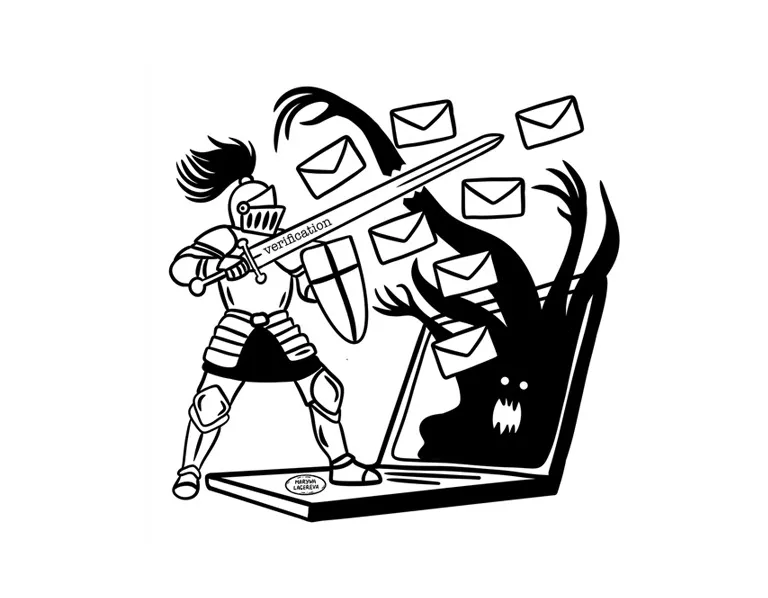
At my grandparents’ house, summer came with an escort. You could not walk from the garden to the kitchen without a delegation forming behind you, mostly flies, plus whatever the heat had woken up that week. And the house faced an impossible choice every July afternoon. Keep the bay windows shut and cook, or open them wide and accept everything the season was offering: the dust, the insects, the moths at dusk, and, some summers, a snake with opinions about the cool of a tiled floor.
Their answer, the strip curtain, hung in the kitchen doorway. Ribbons of plastic you pushed through with your face, which theoretically confused the flies and practically confused the grandchildren. It half worked, the way all its descendants half work. I have been walking through that doorway in my head for years, wondering what the finished version looks like.
The first force field I ever walked through was made of plastic ribbons and my grandmother’s optimism.
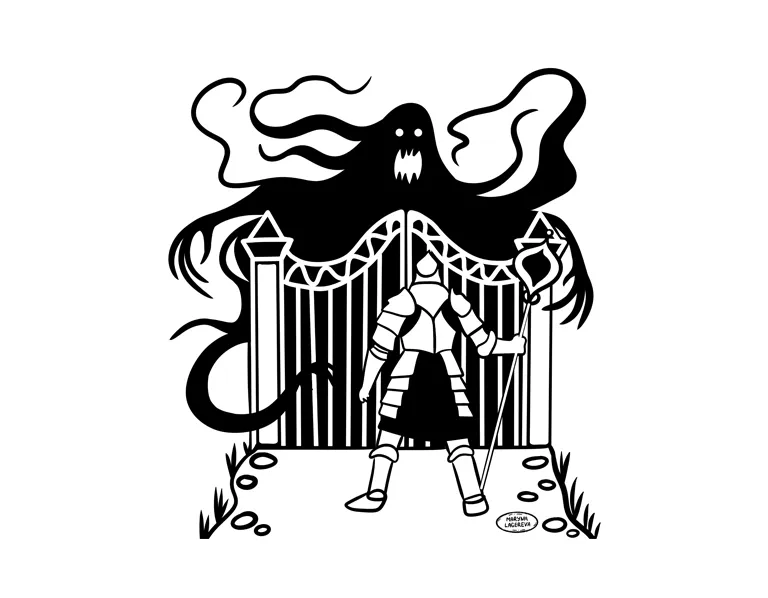
Here is the finished version, the sixth climb up this site’s science fiction ladder (after the storm, the gun, the collar, the air and the Devil’s Trill). A film across the open doorway, thin and transparent, almost not there. When someone on the guest list walks through, it turns fluid and parts around them exactly, hugging their outline, suitcase included, sealing behind their heels. For everything else that moves and breathes (the fly riding your shoulder, the mouse at the sill, the July snake) it stays politely, immovably firm. Throw a cardboard box through and it passes. It is not alive, and the door has no quarrel with it. The window stays open all summer. The house chooses its guests.
Four Ancestors, All in Stores
The strange thing about this dream is how much of it is already for sale in pieces. The strip curtain begat the magnetic screen, two panels of mesh that snap themselves shut behind you, whose product pages proudly note that cats and dogs pass freely, meaning, by construction, the neighbor’s cat and anything else that pushes. Mine got field-tested. The dog pushed through but still gave it a few paw swipes, the cat tried to tear it outright, and in both cases the mesh lost. Supermarkets solved the problem differently with the air curtain, a wall of blown air over the entrance that humans cross without noticing and flies cannot fly through. That is a selective fluid barrier, selecting by mass, and its weaknesses sketch my film precisely: it is loud, it is hungry, and it does nothing about what crawls in at floor level.
And then there is the microchip cat flap, the ancestor that already does the whole concept, recognition included, at a height of fifteen centimeters. It reads the chip implanted in your cat, unlocks for that cat alone, and leaves the neighborhood’s raiders outside. Everything this essay wants has shipped, for pets, years ago. The rest is a question of scale, and of teaching the door to see.
Eyes, Brain, Muscle
My first mental image of the mechanism was a curtain of lasers, beams filling the doorway like a moucharabieh of light, parting only for the authorized. I have to give that image up before repurposing it, because light does not push. A laser grid can see a gnat at a tenth of a millimeter but cannot stop one, and a beam strong enough to be a wall would be an oven. So the light becomes the nervous system, and matter stays the muscle.
The eyes exist, off the shelf. Industry has sold “light curtains” for decades, lattices of infrared beams that guard dangerous machines and halt the press the instant anything interrupts them. Add the depth sensors phones already carry, a thermal camera to tell the warm from the cold, and my favorite instruments in the whole dossier, wingbeat sensors. Smart mosquito traps already identify an insect’s species, even its sex, from the frequency of its wingbeats crossing a beam. This door would not see “a small moving dot.” It would optically hear “tiger mosquito, female” on approach.
The brain is ordinary 2026 video. Real-time silhouette segmentation is the same commodity model that cuts you out of your background on every video call, luggage included. The guest list runs on upgraded cat-flap logic, with a token you carry, or a face, or a gait. And the living-versus-not rule falls out of the sensor stack. The mouse is warm, so it is alive, so it waits outside. The thrown box is cold and ballistic and passes. The insect is neither warm nor chipped, but it flaps, and the wingbeat sensor catches what the thermal camera cannot. Each layer covers another’s blind spot.
The muscle comes in three grades, from real to fiction. Air comes first, with steerable jets in the frame firing where the vision points and stripping the hitchhiker off your shoulder as you cross. It is supermarket technology with aim. Then the membrane itself, which materials science has been quietly preparing. Sheets that switch between drape-soft and board-stiff on command exist in soft robotics as “jamming” layers, and fluids that harden in milliseconds under a magnetic field already ship inside car suspensions. The science fiction is not the switching but the resolution, a film whose stiffness is pixelated finely enough to melt a hole in the exact shape of you, suitcase and all, opening slightly ahead of your stride like a focus that predicts.
And the laser survives in its one honest physical role, as a sniper rather than a wall. A fence that tracked mosquitoes in flight and shot them down was demonstrated on a conference stage in 2010 and has never shipped since, eye safety being one of the reasons. My door inherits both the trick and the caution. The glowing veil of my first image survives too, as pure cosmetics. The door can display its own boundary as light, so humans know where the border is. The border is photons for the eye, air and matter for the fly.
A Bouncer, Not a Prison
Now the doctrine, because a barrier that chooses needs rules more than it needs watts. First rule: fail soft. The film yields to any human-scale force, always. My clumsy fall through it is a legal requirement, not a design flaw. No fire code on Earth allows an exit that holds you in. After a power cut, a sensor crash, or a dead battery, it degrades into what my grandparents had, a curtain. The first wall in history whose failure mode is hospitality.
Second rule, and it is the heavier one: a door that recognizes is a biometric camera aimed at your threshold, all day, forever. It knows who came home, when, with whose suitcase. The anti-fly curtain is one firmware update away from being the household’s ledger. So the doctrine borrows from the way phones guard faces. Everything stays on the chip, nothing is stored, nothing is transmitted, and the guest list lives inside the doorframe the way your face lives inside your phone’s secure enclave. The door watches, and the door forgets. That sentence belongs in the product’s constitution, not its marketing.
The Screen’s Last Form
I want to close the loop on why this is more than comfort. The humble window screen is arguably one of the cheapest public-health technologies ever deployed, and its job is getting harder. Malaria still kills roughly 600,000 people a year by the WHO’s count, dengue is expanding, and the tiger mosquito is walking its way north through Europe with the climate as an accomplice. A doorway that lets the summer in and keeps its escort out is a quality-of-life toy in my grandparents’ kitchen and a public-health instrument two latitudes south. The film is where the screen was always heading, and it arrives just when the screen’s workload is growing.
Here is one fragment you could build this season, in the spirit of this site. A doorframe bar with an insect sensor and an aimed puff of air, a fan with a guest list, no membrane required. It would not stop the snake. It would settle, cheaply, the only question that matters. How much of the summer delegation can eyes and air turn away before anyone needs the science fiction? If you build it, tell me.
So here is what I keep turning over. Once a house can choose its guests down to the species, where do we stop writing the list, and who in the household gets to hold the pen?